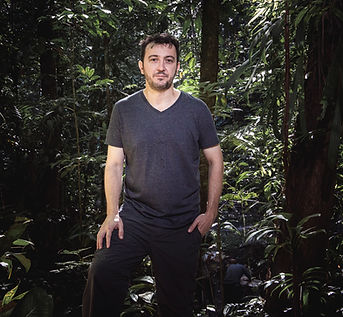
Article: The Amazon That Never Appears in Photos: And Why It Is Essential
Prof. Dr. Leandro Juen
Researcher at the Biodiversity Research Consortium Brazil–Norway (BRC) · Federal University of Pará (UFPA)
When we talk about Amazonian biodiversity, many people immediately think of the forest itself, of large-scale landscapes, towering trees, mammals, birds, and the things that are most visible to our eyes. But there is a vast portion of this biodiversity that almost never appears in the most familiar images of the Amazon.
Small, hidden, aquatic, subterranean, microscopic, and functional biodiversity is extremely important for ecosystem services. When we talk about pollination for fruit production, biological control that helps reduce pests, or the processes that keep stream waters clean, all of this depends on this invisible biodiversity.
In Amazonian streams, for example, there is an extraordinarily rich web of life that often goes unnoticed. Aquatic insects, small fish, aquatic plants, zooplankton, phytoplankton, microscopic fungi, and many other organisms sustain processes that are fundamental to the functioning of these ecosystems.
“For us to have fish, a product so valued in the Amazon, this entire network of biodiversity must be functioning.”
These organisms participate in the decomposition of organic matter, nutrient cycling, water quality maintenance, and the stability of food chains. One important point is that biodiversity is not merely a list of species. Biodiversity is functionality, interaction, balance, and the ability of ecosystems to continue producing clean water, regulating the climate, maintaining food systems, supporting cultures, and ensuring quality of life.
Our work in the Amazon, especially with streams and aquatic insects, has shown that very small organisms can reveal very large environmental changes. Often, long before people visually perceive that an environment has been degraded or altered, aquatic insect communities are already signaling these changes.
Perhaps one of the things people least realize is that Amazonian biodiversity is not only found in what is large and visible. It exists in the smallest details. And very often, it is these details that keep the Amazon alive.
It is impossible to conserve, restore, or sustainably use what we do not know. Today, much is said about the bioeconomy and the Amazon’s great potential for conservation through this pathway. Yet the Amazon, one of the most biodiverse regions on the planet, remains poorly understood in terms of many of its species, ecological functions, and responses to environmental change.
Estimates indicate that the Amazon is home to around 10% of all known species on Earth: one in every ten known species in the world lives here. This proportion varies across groups: about 18% of the world’s vascular plants are found in the Amazon, along with 14% of birds, 9% of mammals, and 18% of fish species. Among dragonflies, the group I work with, Brazil has approximately 820 species, and 400 of them have been recorded in the Amazon.
And there are still many places we have not been able to sample adequately. These 10% are certainly underestimated, and the actual proportion is likely much higher.
Today, the Amazon faces enormous pressures: deforestation, climate change, fires, mining, infrastructure expansion, land-use change, and alterations to aquatic environments. These impacts do not affect only the standing forest. They also affect streams, fish, aquatic insects, plants, microorganisms, and the human populations that depend on these systems.
Understanding Amazonian biodiversity also means understanding how the Amazon itself functions. Every species has an evolutionary history, an ecological role, and a relationship with its environment. When we lose species or simplify ecosystems, we risk compromising essential processes such as climate regulation, water maintenance, soil fertility, and ecosystem resilience in the face of climate change.
“The Amazon can only become the foundation of a fair and sustainable bioeconomy if its biodiversity is understood, valued, and protected.”
Scientific research plays a fundamental role because it helps transform perception into evidence. We often know that the environment is changing, but we need to understand how it is changing, which organisms are being affected, which ecological processes are being compromised, and which actions can support conservation or recovery.
In the Amazon, scientific research is even more important because we are dealing with a region that is highly diverse, immense in scale, and still poorly understood in many respects, what we call knowledge gaps. Approximately 52% of the Amazon still has unknown biodiversity in these areas.
We urgently need to invest in basic science in the Amazon if we want to transform it into a true bioeconomy potential. It is not enough to import ready-made models from other regions of Brazil or the world. We need to produce knowledge rooted in the Amazon itself, through Amazonian institutions, researchers who understand the territory, and partnerships with local communities grounded in respect, where people are actively heard and knowledge is co-produced with Indigenous peoples, traditional communities, and different sectors of society.
In our case, we have been working with aquatic organisms, especially insects, fish, and aquatic plants, to understand how Amazonian streams respond to land-use change, mining, forest loss, and other human pressures. These organisms function as ecological sensors and help indicate whether an environment is intact, altered, or in the process of recovery.
Research also allows us to move beyond conservation based solely on reacting to problems and toward conservation grounded in planning. With high-quality data, we can identify priority areas, monitor impacts, evaluate restoration measures, and guide public policy.
The Biodiversity Research Consortium Brazil–Norway (BRC) is important in this context because it strengthens a collaborative research agenda, connecting different institutions and forms of knowledge to address challenges that are too large to be solved in isolation. Conserving Amazonian biodiversity requires long-term science, cooperation, training, and commitment to the territory.
“At its core, scientific research helps us ask an essential question: what kind of Amazon do we want to leave for future generations?”
And more than that: it helps us find pathways for the Amazon to remain alive, diverse, and increasingly capable of sustaining life, culture, and the future.
Prof. Dr. Leandro Juen is a biologist, professor at the Federal University of Pará (UFPA), and researcher at the Biodiversity Research Consortium Brazil–Norway (BRC). He specialized in aquatic insects and the ecology of Amazonian streams.